
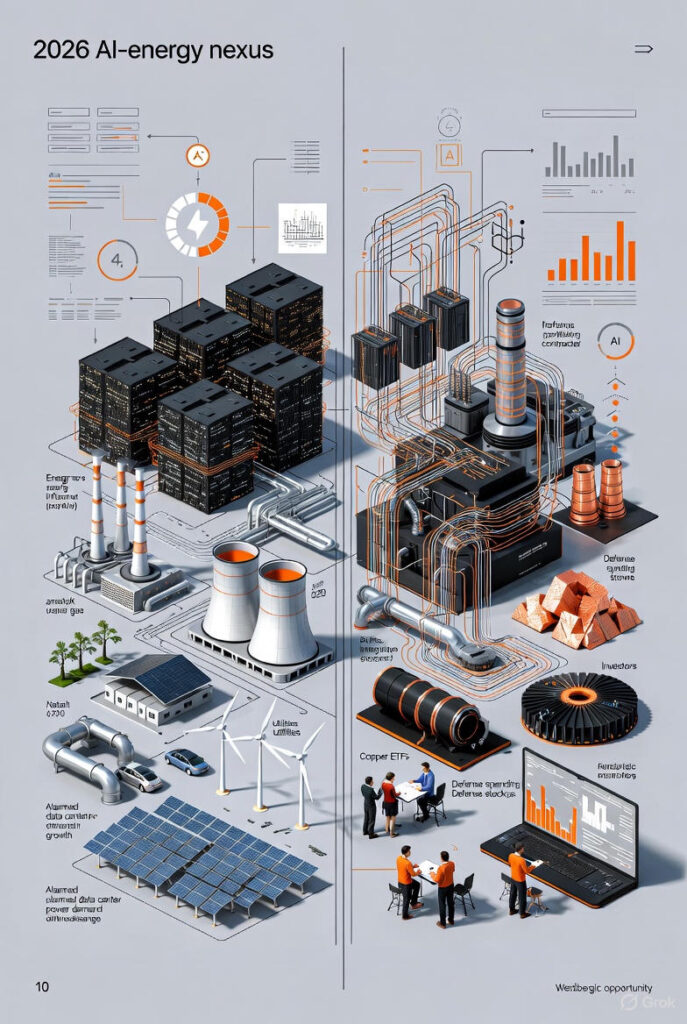
Everyone’s talking about investing in AI companies, but most retail investors are looking at the wrong part of the value chain. The Nvidia shares and OpenAI hype get all the attention, and sure, those might work out great. But the real money over the next decade isn’t necessarily in the algorithms or the consumer-facing chatbots. It’s in the unglamorous infrastructure making all of it possible.
Data centers are experiencing a buildout unlike anything since the early internet boom, except the scale is much larger. These aren’t small server rooms tucked into office buildings – we’re talking about facilities consuming more electricity than small cities, sprawling across hundreds of thousands of square feet, operating 24/7 at full capacity. Training a single large language model can use as much power as hundreds of homes consume in a year. Every major tech company is racing to build capacity, and they’re all competing for the same limited resources: land near power sources, cooling systems, construction capacity, and grid connections.
The numbers are staggering. Microsoft alone has committed to spending over $80 billion on AI infrastructure in 2025 and 2026. Google, Amazon, and Meta are in similar spending races. Oracle is building data centers that will consume more than a gigawatt of power – equivalent to a large nuclear power plant’s output. This isn’t speculative investment that might pay off someday; this is capital expenditure happening right now, with real construction crews and actual equipment orders.
Virginia’s Loudoun County, already nicknamed “Data Center Alley,” is seeing unprecedented growth. Power demand in that single county is projected to increase by 60% over the next five years, almost entirely from data center expansion. Texas, Oregon, Iowa, and Arizona are all competing aggressively to attract data center development with tax incentives and favorable utility rates.
The energy angle gets more interesting when you dig into what powers these centers. Natural gas plants are being built specifically to serve data center clusters because they can scale up quickly and provide reliable baseline power. Nuclear energy is getting a second look from tech companies because it provides consistent power that renewables can’t always guarantee. Microsoft has even explored building small modular reactors specifically for data center use.
Some utilities in Virginia and Texas are projecting electricity demand growth they haven’t seen in decades, driven almost entirely by AI infrastructure and, secondarily, electric vehicle charging. Commonwealth Edison in Illinois estimates data centers will add the equivalent of several hundred thousand homes worth of electricity demand over the next five years. These utilities are having to make massive investments in transmission infrastructure, substations, and generation capacity.
The renewable angle is complicated. Tech companies have committed to carbon neutrality goals, which means they want clean energy powering their data centers. This has driven enormous investments in solar and wind projects, often with power purchase agreements directly from data center operators. But renewables introduce intermittency problems – the sun doesn’t always shine, the wind doesn’t always blow. So you end up needing either battery storage (expensive and still limited in scale) or natural gas backup (cheaper but not carbon neutral).
This energy crunch is creating investment opportunities across the entire power sector. Utilities serving major data center markets are seeing their growth projections revised upward substantially. Natural gas producers and pipeline operators benefit from increased demand. Nuclear power plant operators, many of which were facing uncertain economics, are suddenly fielding inquiries about long-term power contracts. Even coal plants that were scheduled for retirement are getting extended lifespans in some regions because the power is needed.
Copper sits at the center of this entire buildout, and the supply-demand situation is getting tight. Every data center needs miles of copper wiring for power distribution and networking. The shift to renewable energy (partially driven by tech companies trying to meet carbon goals) requires even more copper for solar panels, wind turbines, and the transmission infrastructure connecting them to the grid. Electric vehicles need roughly four times the copper of traditional cars, and EV adoption is accelerating faster than most forecasts predicted.
Meanwhile, major copper mines are aging and new discoveries aren’t replacing depleted reserves fast enough. It takes 10-15 years to develop a new copper mine from discovery to production, and global exploration spending has been relatively low for the past decade. Several large mines in Chile and Peru, which together produce about 40% of global copper, are seeing declining ore grades as they dig deeper.
The copper price has always been cyclical, but the structural demand from electrification and AI infrastructure suggests we’re entering a different regime. Previous copper booms were driven by industrialization in developing countries. This boom is driven by developed economies rebuilding their entire energy and transportation infrastructure while simultaneously building computing capacity at unprecedented scale. Those demand drivers aren’t going away if the economy slips into recession.
Defense spending on AI capabilities has accelerated faster than most people realize, and it’s not just about autonomous drones or battlefield technology. Cybersecurity, signals intelligence, satellite reconnaissance, and threat detection are all being rebuilt around AI systems. Every major military is treating AI advancement as a national security priority, which means defense budgets are flowing heavily into contractors with credible AI programs.
The US Department of Defense designated AI as a critical technology focus area, with billions allocated specifically for AI development, testing, and deployment. China has publicly stated its goal to become the world leader in AI by 2030 and is backing that up with massive government spending. European nations are coordinating AI defense initiatives through NATO. This isn’t hype – these are actual budget line items with congressional appropriations behind them.
Defense contractors that successfully integrate AI into their product lines are seeing multiyear contract pipelines that provide unusual revenue visibility. Palantir, while controversial, has grown substantially on the back of AI-powered defense analytics. Northrop Grumman, Lockheed Martin, and Raytheon are all investing heavily in AI capabilities. Even traditional hardware contractors like General Dynamics are racing to add AI features to their systems.
The portfolio play isn’t straightforward, which means there’s still alpha available for investors who do the homework. You could buy individual stocks in utility companies serving major data center markets, copper mining companies with long reserve lives, or defense contractors with demonstrated AI contracts. But each carries specific risks – utilities face regulatory challenges, miners deal with commodity price volatility and geopolitical risk, defense contractors depend on government budget cycles.
Diversified infrastructure ETFs offer exposure without betting everything on one company’s execution. Some investors are looking at industrial REITs that own data center properties, capturing the real estate appreciation and rental income without operational risk. There are copper-focused ETFs that hold baskets of mining stocks. Defense-specific ETFs have existed for years but are now getting attention for their AI exposure.
For investors comfortable with more complexity, there are second-order plays. Companies that make cooling systems for data centers, manufacturers of high-voltage transformers for grid upgrades, specialized construction firms building these facilities. These businesses are less obvious but potentially less crowded from an investment perspective.
Timing matters less than positioning here. This isn’t a quick trade based on quarterly earnings beats – it’s a structural shift that plays out over years, maybe decades. Missing the first 20% of a ten-year trend doesn’t ruin the opportunity. Getting exposure before the trend becomes obvious to everyone? That’s where returns compound into something meaningful.
The risk case deserves consideration too. AI hype could cool off, leading to scaling back of infrastructure spending. We might hit physical or economic limits on data center buildout sooner than expected. Copper prices could crater if a major new mine comes online or if recycling technology improves dramatically. Defense spending could get cut if geopolitical tensions ease or if budget pressures force hard choices.
But the base case – that AI becomes genuinely embedded in how economies function, that this requires massive physical infrastructure, and that the companies building and powering that infrastructure will capture value – seems pretty solid. You’re not betting on whether one AI startup succeeds or fails. You’re betting on the picks and shovels that every AI company needs to function.