
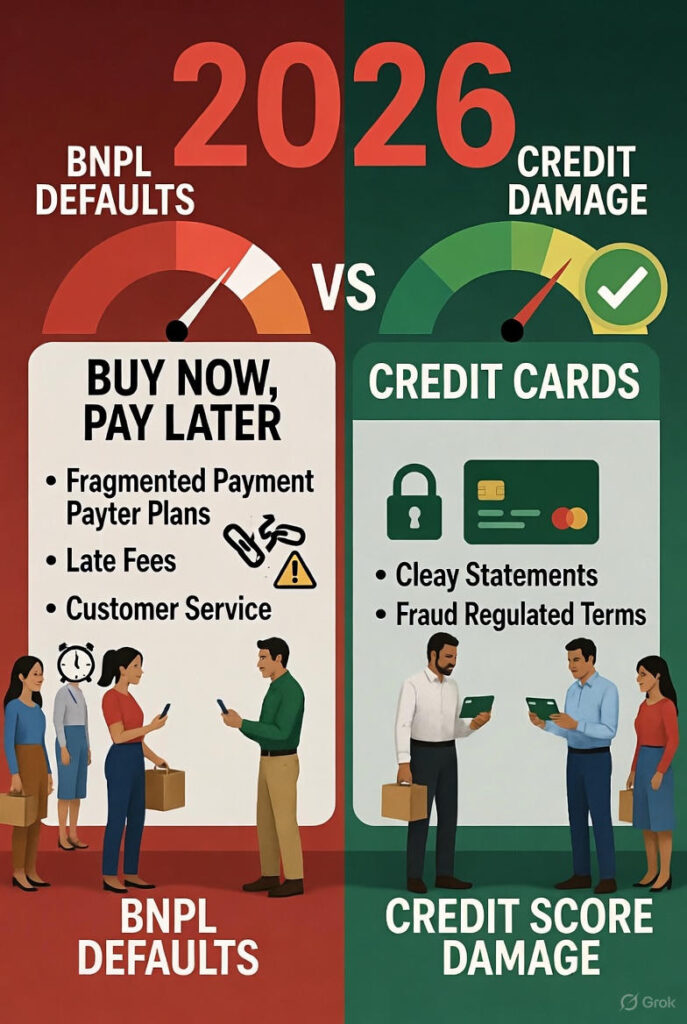
Buy Now, Pay Later companies promised to disrupt credit cards by offering interest-free installment plans with minimal friction. For a while, maybe 18 months starting in 2022, it worked exactly as advertised. Shoppers split purchases into four equal payments, managed their budgets better, avoided credit card interest, and everyone seemed happy. BNPL companies grew explosively, retailers loved the higher conversion rates, and consumers felt they’d found a better way to manage cash flow.
Then the late fees started piling up. And the defaults. And the credit score damage that nobody warned users about clearly enough. And the customer service nightmares when things went wrong.
The problem with BNPL isn’t the concept – spreading payments over time makes perfect sense for many purchases. The problem is the execution combined with human psychology and, frankly, some questionable business practices that emerged as these companies tried to become profitable.
When you use a credit card, you get one monthly statement showing everything you bought. One payment date, one balance, one minimum payment, one customer service number if you have issues. It’s consolidated. You can see your total debt load at a glance. Even if you’re bad at managing money, at least all your credit card debt is visible in one place.
BNPL is the opposite by design. You might have four different payment plans running simultaneously across three different platforms, each with different due dates, different payment amounts, and different rules about what happens if you miss one. The fragmentation is built into the model.
Let’s walk through a realistic scenario. Say you bought shoes with Afterpay on January 5th, payments due the 15th of each month. Then you bought a couch with Affirm on January 12th, payments due the 22nd. Then concert tickets with Klarna on January 18th, payments due the 28th. And clothes with Zip on January 24th, payments due the 8th of the following month.
You’re now managing sixteen different payment dates spread across eight months, assuming all four purchases were split into four payments. Miss one by a few days because you genuinely forgot which date Klarna charges your account? Late fee. Miss it by a week because you were traveling? Another late fee plus potential credit reporting. Some platforms report to credit bureaus, some don’t, and the criteria for when they report are inconsistent.
The fee structure varies wildly between platforms in ways that aren’t always transparent during checkout. Some BNPL services charge $7 for a late payment. Others go up to $30. Some give grace periods of a few days, others charge the fee immediately if payment fails. A few will lock you out after one missed payment, while others let you spiral into a debt cycle with mounting fees before finally cutting you off.
There’s no standardization, which makes it nearly impossible to compare terms before you sign up. You’re clicking through during checkout, eager to complete your purchase, and the BNPL terms are buried in legal text that nobody reads. By the time you understand the fee structure, you’ve already committed to the payment plan.
Credit cards are starting to look reasonable again by comparison, which is not something anyone expected to be saying a few years ago. Yes, credit cards charge interest if you carry a balance, and those APRs are often brutal – 18% to 28% is common. But credit cards are regulated more heavily under laws like the CARD Act, which limits certain predatory practices. They offer clearer terms that are standardized across the industry. They provide better fraud protection because of regulation requiring zero liability for unauthorized charges. They report to credit bureaus in ways that can actually help your score if you manage them responsibly.
Plus you can see your full debt load in one place instead of scattered across multiple apps that don’t talk to each other. This visibility matters more than people realize. When all your debt is on one statement, you can’t hide from it psychologically. When it’s fragmented across four different platforms, it’s easier to lose track of how much you actually owe.
The BNPL industry is facing a reckoning. Default rates climbed throughout 2025, forcing platforms to tighten approval standards and increase fees to cover losses. Affirm, Afterpay, and Klarna all reported higher-than-expected charge-offs, meaning customers weren’t paying and the companies had to write off the losses. This led to a vicious cycle – to stay profitable despite losses, they increased fees, which made the services less attractive, which drove away better customers, leaving a higher concentration of risky users.
Some BNPL companies are pivoting toward looking more like traditional installment loans, complete with interest charges and upfront credit checks. At that point, what exactly are they offering that’s different from a personal loan or credit card? The original value proposition was interest-free, frictionless access. Start adding interest and friction, and you’re just another lender with a slightly different interface.
For consumers trying to decide between BNPL and credit cards in 2026, the choice isn’t as simple as “BNPL bad, credit cards good.” It’s about understanding what you’re signing up for and being honest about your ability to manage the obligations.
If you can genuinely afford the purchase, have systems to track multiple payment dates, and won’t be running multiple BNPL plans simultaneously, the services still work fine. Use BNPL for one-off large purchases where you want to spread the cost without paying interest. Just like you might use a 0% APR credit card offer for the same purpose.
But if you’re using BNPL because you can’t afford the full purchase price right now, you’re setting yourself up for late fees that often exceed what credit card interest would have cost anyway. Running the numbers makes this clear. A $400 purchase split into four payments with two missed payments incurring $25 fees costs $450 total. That same $400 on a credit card at 20% APR paid off over four months costs about $416 in total. The BNPL late fees can actually be more expensive than credit card interest.
The hidden cost nobody talks about.