Financial advisors love giving the same tired advice. Cancel Netflix. Make coffee at home. Pack your lunch. Stop buying lattes. These tips aren’t wrong exactly, but they’re small. Incremental. The kind of savings that add up to maybe $150 monthly if you’re disciplined about it, which most people aren’t because the sacrifice feels bigger than the reward.
Meanwhile, three massive expenses are quietly consuming 60% to 75% of your income every single month. Housing, transportation, and food. These aren’t luxuries you can just eliminate. You need somewhere to live, some way to get around, and obviously you need to eat. But the way most people approach these necessities is leaving huge amounts of money on the table.
The real savings, the kind that actually changes your financial trajectory, comes from optimizing these big three. Not through deprivation or adopting some punitive rice-and-beans lifestyle, but through strategic choices that make your money work harder without making you feel like you’re struggling. Think of it as finding the backdoor to financial freedom while everyone else is trying to squeeze through the front door by cutting $5 subscriptions.
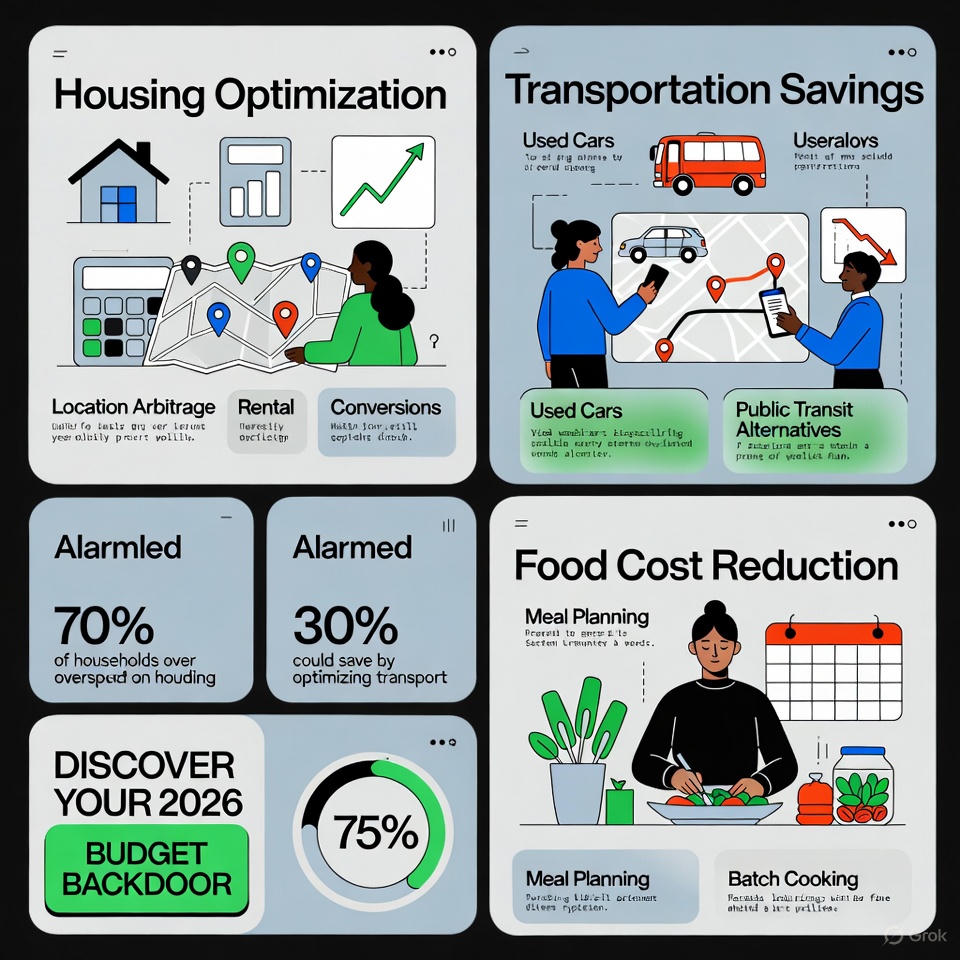
Housing: The Location Arbitrage Play
Housing is almost certainly your biggest expense. For most people, rent or mortgage payments represent 30% to 40% of their monthly income, sometimes more in expensive cities. The standard advice to “downsize” typically means moving to a smaller, less appealing place in the same area. That approach works, but it feels like a downgrade. You’re trading space and comfort for savings, which psychologically registers as moving backwards in life.
There’s a smarter way that doesn’t involve feeling like you’re settling for less.
Location arbitrage means trading prestige for cost while keeping everything else roughly the same. Cities and metro areas don’t price housing in a linear way based on distance from the center. The price curve is steep near downtown or desirable neighborhoods, then flattens out quickly once you cross certain invisible boundaries. You can often move fifteen minutes further out and see housing costs drop 20% to 30% while your actual quality of life barely changes.
Think about how this works in practice. Say you’re renting in a trendy neighborhood close to downtown. You’re paying $2,500 monthly for a two-bedroom apartment. You can walk to restaurants, there’s nightlife nearby, you feel connected to the action. Now look at neighborhoods exactly fifteen minutes away by car, train, or bike. Not forty-five minutes into the suburbs where you’d need to plan your social life days in advance. Just fifteen minutes.
What you’re giving up is often pretty minimal. The ability to walk to that specific coffee shop you like. Living in the neighborhood where everyone says they want to live. The five-minute commute becoming a twenty-minute commute. For most people, these are not life-altering sacrifices.
What you’re gaining is substantial. That same two-bedroom apartment might cost $1,800 or even $1,600 in the slightly less prestigious neighborhood. You’re saving $700 to $900 monthly, which is $8,400 to $10,800 annually. Your apartment is probably the same size, possibly bigger. The neighborhood is often quieter, sometimes safer, frequently has better parking. You haven’t downgraded your living situation – you’ve just stopped paying a premium for being in the exact center of everything.
This works in UK cities too. Living in Zone 2 London versus Zone 3 can mean the difference between £1,800 and £1,300 monthly for comparable flats. That £500 monthly savings is £6,000 annually, which is a genuinely life-changing amount of money for most households.
The psychological win here matters. You’re not moving to a worse place. You’re moving to a place that’s basically the same but costs significantly less because it’s not in the hyped-up core. You can tell people you moved to a quieter neighborhood, which sounds like a lifestyle choice rather than a financial compromise. Which it is.
For homeowners, there’s an even more powerful strategy if you’re willing to get creative. Converting existing space – a basement, an attic, a garage, even building an accessory dwelling unit in the backyard if local zoning allows – into a legal rental unit can fundamentally change your housing math. Your tenant’s rent covers a huge chunk of your mortgage payment, sometimes all of it.
This requires upfront capital and dealing with the reality of being a landlord, which isn’t for everyone. But the financial impact is hard to ignore. If your mortgage is $2,200 monthly and you’re collecting $1,200 in rent from your basement unit, your actual housing cost just dropped to $1,000. You’re effectively living in a house for less than you’d pay for an apartment, and you’re building equity the whole time.
Transportation: Breaking the Car Ownership Trap
The average American household spent nearly $12,000 on transportation in 2024. UK households averaged over £4,000. These aren’t small numbers, and they’re mostly locked into recurring costs – car payments, insurance, fuel, maintenance, registration fees, parking. The automotive industry has built an entire economic system designed to keep you paying continuously.
Breaking free requires decoupling your need for mobility from car ownership, or at minimum, dramatically reducing the cost of the car you do own.
New cars are financial disasters masked as shiny status symbols. The depreciation hit on a new vehicle is brutal – 20% to 30% in the first year alone. You’re paying a massive premium to be the first owner, and that premium evaporates the moment you drive off the lot. It’s one of the worst financial decisions you can make repeatedly, yet millions of people do it every few years.
If you genuinely need a car, buy used. Specifically, buy a reliable used car that’s three to five years old. This is the sweet spot where you’re capturing the steepest depreciation that already happened to someone else, but the car is still modern, safe, and covered by remaining warranty in many cases. You’re getting basically the same vehicle for 40% to 50% less money.
The brands matter here too. Certain manufacturers – Toyota, Honda, Mazda in the US; similar reliability leaders in the UK market – hold value better and require less maintenance. A five-year-old Toyota Camry or Honda Civic is still a perfectly good car with years of life left, but it costs half what it did new. A five-year-old luxury vehicle might seem like a deal until you hit it with maintenance costs that assume you have new-car-buyer income.
Insurance and financing are places where people leave money on the table constantly. Most people set up their car insurance and never look at it again. That’s a mistake worth hundreds annually. You should be shopping your insurance every single year. Switching providers, adjusting coverage levels, removing unnecessary add-ons – this takes maybe fifteen minutes and commonly saves $200 to $500 annually in the US, £150 to £400 in the UK.
Same with car loans if you’re financing. Interest rates change, your credit score improves, new lenders enter the market. Refinancing a car loan when you can shave even 1% off the APR saves hundreds over the life of the loan. On a $30,000 loan, dropping from 6% to 5% saves roughly $900 over five years. That’s free money for an hour of paperwork.
But here’s where it gets interesting. For a growing number of people, particularly those in cities or near decent public transit, the question isn’t how to make car ownership cheaper – it’s whether you need to own a car at all.
Run a cost-per-use calculation. Add up everything your car costs monthly: payment or depreciation, insurance, fuel, parking, maintenance reserves, registration. For many people, this totals $500 to $700 monthly. Now count how many days per month you actually need a car for something you couldn’t accomplish with walking, biking, public transit, or a rideshare app.
If you’re only using your car eight days a month for things that truly require a vehicle, you’re paying $60 to $85 per use when you factor in all ownership costs. You could rent a car for most of those trips for $50 to $80 daily and still come out ahead, and you wouldn’t have any of the ownership hassles.
This math doesn’t work for everyone. If you live in a car-dependent suburb, have kids you’re shuttling around, or your job requires a vehicle, then ownership makes sense. But urban dwellers and remote workers often discover they’re maintaining an expensive asset they barely use out of habit rather than necessity. Selling the car and using a combination of alternatives – bikes for short trips, transit for commutes, car shares or rentals for the occasional weekend trip – can drop transportation costs from $600 monthly to under $150.
The psychological barrier is losing the optionality. Having a car in your driveway feels like freedom even if you rarely use it. But that freedom costs $7,000+ annually. Is it worth it, or is it just expensive peace of mind for situations that rarely arise?
Food: Making Home Cooking Feel Like an Upgrade
Food spending is where people fail hardest at cutting costs because most approaches make you feel deprived. Eating plain chicken breast and steamed broccoli every night technically saves money, but it’s miserable. Within two weeks you’re ordering pizza because life’s too short for joyless meals.
The average household spends roughly half their food budget on restaurants, takeout, and delivery. The markup on restaurant food is insane – typically 300% to 500% over ingredient costs. A meal that costs $6 in groceries to make at home gets charged at $25 as takeout once you factor in labor, overhead, and delivery fees.
The trick isn’t eliminating restaurants entirely. It’s shifting most of your eating to home while making that food actually enjoyable. You’re not trying to eat like someone on a depression-era budget. You’re trying to eat well at home so you don’t feel the need to pay restaurant prices except for special occasions or genuine convenience needs.
The 80/20 approach works well here. Aim to make 80% of your meals at home, but make them good. Use the money you save from skipping two restaurant meals to buy premium ingredients for exceptional home cooking. Splurge on the good steak, the fresh fish, the imported cheese, the nice wine. You’re still spending way less than you would dining out, but the meal quality is comparable or better.
Meal planning gets recommended constantly, usually with the wrong framing. People present it as a way to eat healthy or save time. Those are fine goals, but the real value is eliminating food waste. Food waste absolutely destroys grocery budgets because you’re paying for items that end up in the trash.
When you plan your week’s meals before shopping, you buy exactly what you need. That produce doesn’t rot in the crisper drawer. Those leftovers get incorporated into the next meal. That random ingredient you bought for one recipe doesn’t sit unused until it expires. Most households waste 15% to 25% of their grocery spending this way. Meal planning captures that waste as savings with almost no downside.
The psychological shift that makes this sustainable is focusing on building cooking skills rather than just following recipes. Learn one new technique monthly – how to properly sear a steak, how to make a pan sauce, how to cook rice perfectly, how to roast vegetables so they’re actually good. Each skill you master makes home cooking more satisfying and expands what you’re capable of making without stress.
Someone who can confidently cook a restaurant-quality steak dinner at home for $20 doesn’t feel deprived when they skip the $80 steakhouse meal. They feel smart. That psychological difference is everything for sustainability.
Batch cooking amplifies all of this. The biggest reason people order takeout isn’t that they prefer restaurant food – it’s that they’re tired, hungry, and don’t want to cook right now. If your freezer contains pre-made portions of actually delicious food you cooked last weekend, the convenience factor of takeout disappears.
Spend three hours on Sunday making large batches of components: sauces, grains, proteins, soups, casseroles. Freeze them in single-serving portions. Now throughout the week, you have “takeout” that just needs reheating – except it’s food you like, made exactly how you want it, and it costs $4 instead of $25.
This one habit saves families $400 to $600 monthly compared to their previous takeout spending. That’s $5,000 to $7,000 annually. The time investment is maybe three to four hours weekly, much of it passive cooking time where you’re just monitoring rather than actively working.
The Compound Effect of Big Wins
What makes these three areas powerful is they’re one-time decisions with ongoing returns. You don’t need to maintain daily discipline like with the “skip the latte” advice. You make a decision once – to move to a slightly less central neighborhood, to sell your car or buy used, to adopt meal planning – and the savings happen automatically every month.
A realistic scenario: you move fifteen minutes further out and save $600 monthly on housing. You sell your expensive car, buy a reliable used vehicle, and cut transportation costs by $400 monthly. You start batch cooking and meal planning, dropping food spending by $400 monthly.
That’s $1,400 in monthly savings. Not $1,400 you need to manually transfer to savings each month through sheer willpower. $1,400 that just doesn’t leave your account because your baseline expenses dropped. Over a year, that’s $16,800. Over five years, assuming you invest it with modest returns, that approaches $100,000.
These aren’t numbers you get from skipping coffee. These are life-changing amounts that come from optimizing the big categories everyone else accepts as fixed costs.
The backdoor to financial freedom isn’t suffering through a poverty mindset. It’s getting smarter about the major expenses that most people never question. You can live well, enjoy your life, and still save dramatically by understanding where the real inefficiencies hide in your budget.