
Rent and mortgage payments consume 30% to 40% of most people’s income, sometimes more in expensive cities. It’s the single biggest obstacle to building wealth because you’re spending thousands monthly on housing without building any equity or generating any return. You’re just paying someone else’s mortgage or padding a landlord’s investment account.
House hacking flips this entirely. Instead of paying to live somewhere, you live for free or nearly free by turning your home into an income-generating asset. It’s not a new concept – people have been renting out spare rooms or basement apartments for decades. What’s changed is how accessible this strategy has become for younger buyers, how sophisticated the execution can be, and how dramatically it can accelerate wealth building.
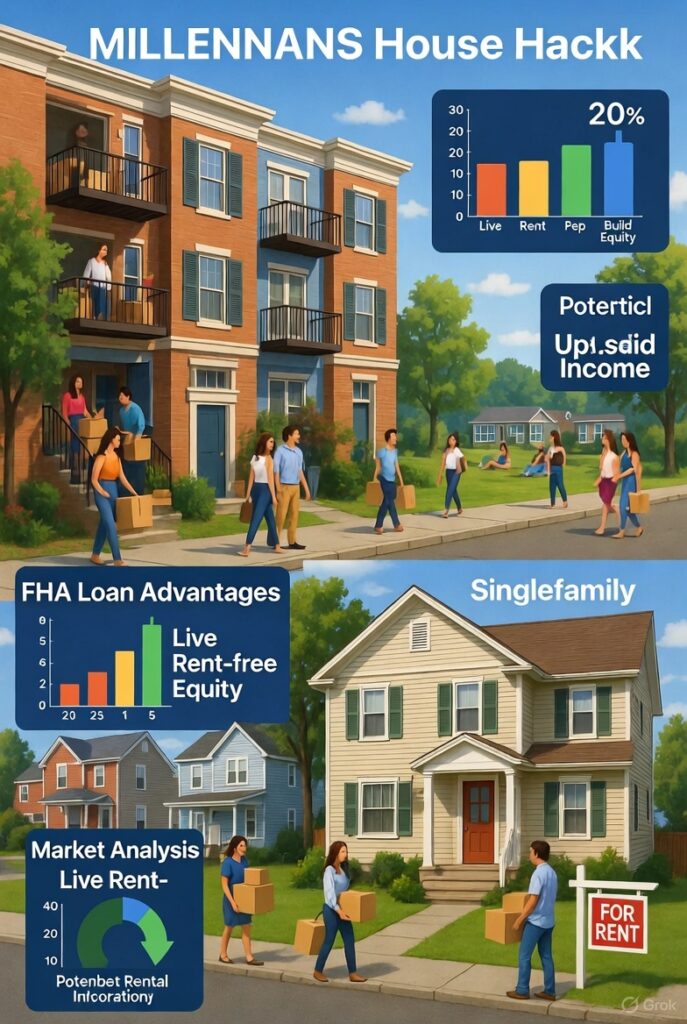
The basic premise is simple. You buy a property – often a multi-unit building or a single-family home with rental potential – live in one unit or part of it, and rent out the rest. The rental income covers most or all of your mortgage payment, property taxes, and insurance. Your housing cost drops to near zero while you’re building equity in an appreciating asset.
The FHA Loan Advantage
The financing piece is what makes house hacking accessible even for people without huge down payments. FHA loans let you buy a property with as little as 3.5% down if it’s going to be your primary residence. Crucially, that property can be up to a fourplex – a building with four separate units.
So you could buy a fourplex for, say, $400,000 with only $14,000 down. Live in one unit, rent out the other three. If each of the rental units brings in $1,200 monthly, that’s $3,600 in rental income. Your mortgage payment on a $386,000 loan at 7% interest would be around $2,570 monthly. Add property tax and insurance, and your total housing cost might be $3,200 monthly.
The rental income covers almost all of it. You’re living basically for free while building equity in a $400,000 asset. After a few years of property appreciation and mortgage paydown, you might have $60,000 to $100,000 in equity. That’s wealth you couldn’t have built if you were just paying rent.
Conventional loans offer another route with slightly different math. They typically require 5% to 15% down for multi-unit properties, but they can finance larger buildings and the interest rates are sometimes better for people with strong credit. The trade-off is needing more upfront capital.
The Single-Family Approach
Not everyone wants to buy a multi-unit building, and in some markets they’re scarce or prohibitively expensive. Single-family homes can work for house hacking too, just with different configurations.
The most common approach is renting out bedrooms. Buy a three or four-bedroom house, live in one bedroom, rent out the others. This works particularly well near colleges or in cities with a lot of young professionals. Three roommates at $800 each brings in $2,400 monthly, which might cover your entire mortgage on a $300,000 house.
The dynamic is different than owning a multi-unit building. You’re sharing common spaces with tenants who are technically roommates. The boundaries get blurrier. But the financial impact can be just as powerful, and single-family homes are more available in most markets.
Another single-family strategy is converting space into a separate rental unit. Basements, garages, even large sheds can be transformed into studios or one-bedrooms with proper permits. This requires upfront investment – maybe $15,000 to $50,000 depending on the scope – but you end up with a rental unit that’s truly separate from your living space.
The permitting question matters here. Many cities have cracked down on unpermitted rental units, and the penalties can be severe if you get caught. Doing it legally takes longer and costs more, but it protects you from fines and gives you legitimate rental income you can report on loan applications if you want to buy more properties later.
Picking the Right Market
Location determines whether house hacking makes financial sense. You need markets where rental income is strong relative to property prices, where multi-unit buildings or houses with rental potential are available, and ideally where property values are appreciating.
College towns work exceptionally well for house hacking. Student tenants tolerate shared housing situations, rents are relatively high because of demand, and there’s constant turnover so you’re never stuck with the same problematic tenant long-term. The challenge is students can be higher maintenance – more noise complaints, more damage, more frequent issues.
Up-and-coming neighborhoods in growing cities offer good opportunities. You’re betting on appreciation while collecting rent. The risk is you might be wrong about the neighborhood’s trajectory, but if you’re right, you benefit from rental income now and substantial equity gains later.
Markets with strong job growth and in-migration are ideal. When people are moving to an area for work, rental demand stays high and property values tend to appreciate. Research where companies are relocating, where new industries are growing, where infrastructure investment is happening. These indicators suggest areas where house hacking will work well.
Avoid markets where rent-to-price ratios are terrible. In some expensive coastal cities, houses cost $800,000 but only rent for $2,500 monthly. The math doesn’t work – your mortgage alone would be $5,000+ monthly. You’d be subsidizing tenants to live with you, which defeats the entire purpose.
Managing the Tenant Relationship
Being a live-in landlord creates unique dynamics. You can’t ignore maintenance issues when you’re living in the same building. You can’t pretend not to notice late rent payments when you see your tenant every day. The proximity forces you to be more engaged, which is both good and bad.
The selection process becomes critical. You’re not just choosing someone financially capable of paying rent – you’re choosing someone you’ll see regularly, possibly daily. Screening needs to balance financial vetting with personal compatibility. Credit checks, income verification, and references are all necessary, but so is meeting people and trusting your gut about whether you can coexist comfortably.
Clear boundaries from day one prevent most problems. Written lease agreements, even for roommate situations, establish expectations around rent, utilities, common space usage, guests, noise. Having everything documented protects both parties and gives you recourse if issues arise.
Some house hackers deliberately seek tenants who travel frequently for work or who keep opposite schedules. A nurse working night shifts or a consultant who’s on the road four days a week makes a excellent tenant when you’re living in the same property. You get the rental income without much daily interaction.
The Exit Strategy
House hacking isn’t meant to be permanent for most people. It’s a wealth-building tool you use for a few years to establish financial foundation, then you move on to whatever’s next.
The classic path is living in the property for at least a year (required for FHA loans), then moving out and renting your unit too. Now all units are producing income, and you can buy another property to house hack using another FHA loan on your new primary residence. After a few cycles of this, you own multiple rental properties that were all purchased with minimal down payments.
Some people house hack until they’ve saved enough for a down payment on their dream home, then convert the house-hacked property to a full rental. The rental income helps qualify you for a larger mortgage on the next property because lenders count rental income toward your debt-to-income ratio.
Others eventually sell the house-hacked property and use the equity gains to invest in something else – maybe stocks, maybe starting a business, maybe buying a larger rental property that doesn’t require living on-site. The years of essentially free housing while building equity create financial flexibility you wouldn’t have had otherwise.
The Challenges Nobody Mentions
House hacking sounds great on paper, and it is genuinely powerful for building wealth. But it comes with real trade-offs that need honest consideration.
Privacy is the big one. Living in the same building as your tenants, or sharing a house with roommates, means giving up the complete autonomy of living alone or with just your partner/family. There are noises, schedules, the feeling of always being slightly “on” because you’re both resident and landlord.
Maintenance falls on you in a much more immediate way than with distant rental properties. When something breaks at 11 PM, you can’t ignore it until tomorrow because you’re also living there. The water heater going out affects you as much as your tenants. This forces you to be responsive, which is good for tenant relations but exhausting when you’d rather just relax.
The lifestyle isn’t for everyone. If you value having your own space, hosting freely without considering tenants, or not dealing with rental property management, house hacking will feel like a burden no matter how good the financial returns are. Money saved isn’t worth it if you’re miserable.
Market timing matters and is unpredictable. Buying in 2026 means hoping property values continue appreciating. If we hit a housing correction, your equity gains could evaporate for a while. The rental income still helps with cash flow, but the wealth-building component slows down or reverses temporarily.
Making the Numbers Work
The practical reality of house hacking requires running detailed numbers for your specific situation. General rules of thumb help, but actual properties in real markets have specific costs and rental potential that determine whether the strategy makes sense.
Start with the purchase price and down payment. Can you actually afford the upfront costs with available cash while keeping an emergency fund? Draining all your savings to scrape together a down payment is risky, especially when you’re also taking on the responsibilities of property management.
Calculate realistic rental income based on comparable properties in the area. Don’t assume you’ll get top-of-market rents – that’s a setup for disappointment. Use conservative estimates and verify them by researching actual listings for similar units.
Add up all your ownership costs. Mortgage principal and interest, property taxes, homeowners insurance, HOA fees if applicable, maintenance reserves (typically 1% of property value annually), utilities you’ll cover, potentially property management software or services. Be thorough – underestimating costs is how house hacking turns from wealth-building into financial stress.
Subtract rental income from total costs. What’s left is your actual monthly housing expense. If it’s close to zero, the strategy works. If you’d still be paying $1,500 monthly after rental income, compare that to what you’d pay renting something you actually want to live in. Maybe the house hacking trade-offs aren’t worth $300 monthly savings.
Factor in your time and effort. Managing tenants, handling maintenance, dealing with occasional issues – there’s a real cost to this even if it’s not purely financial. Some people value their time and peace of mind high enough that paying more for simpler housing makes sense.
House hacking works remarkably well for people in the right circumstances – those who can tolerate the lifestyle trade-offs, who are buying in markets with decent rent-to-price ratios, who have enough capital for a down payment but not enough to build wealth quickly through other means. It’s a legitimate path to living rent-free while building substantial equity, as long as you go in with eyes open about what you’re actually signing up for.