Passive income sounds like fantasy until you understand dividend investing. Companies pay shareholders a portion of their profits quarterly, and if you own enough shares, those payments can become meaningful income. Not overnight, not without capital, but achievable for people willing to invest consistently over time.
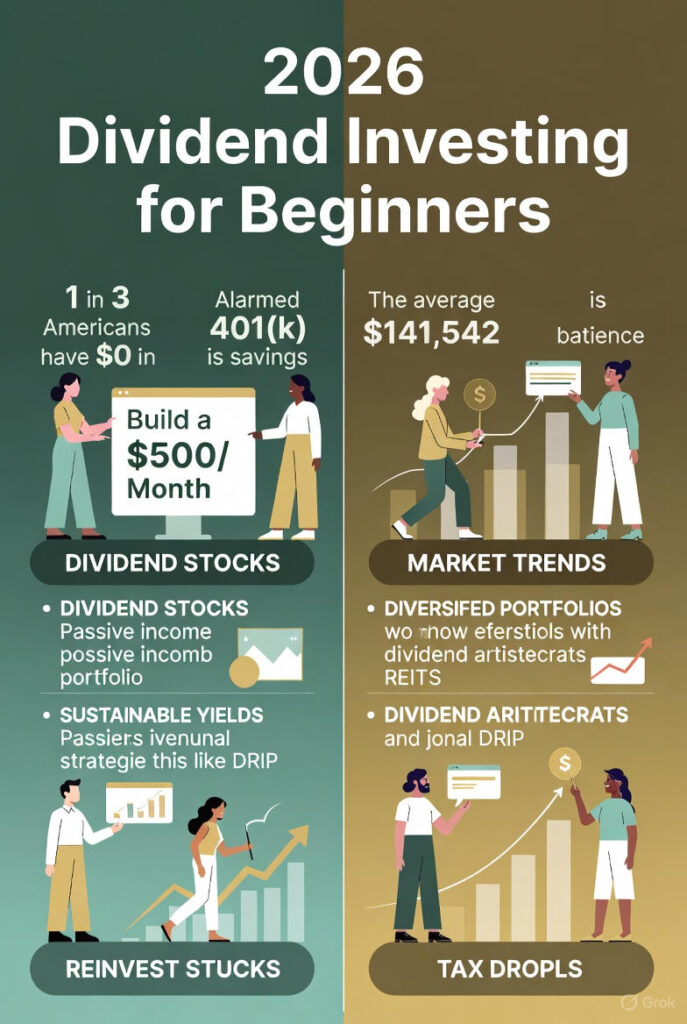
The math is straightforward. If you want $500 monthly in dividend income, that’s $6,000 annually. At a 4% dividend yield, you need $150,000 invested. That number sounds massive, but breaking it down changes the psychology. Investing $1,000 monthly for ten years with dividend reinvestment and modest growth gets you close. It’s not a get-rich-quick scheme – it’s a get-financially-secure-eventually plan.
Understanding Dividend Yields and Sustainability
Dividend yield is the annual dividend payment divided by the stock price. A stock trading at $100 that pays $4 annually in dividends has a 4% yield. This seems simple until you realize yield changes as stock prices move. The company might keep paying the same dividend, but if the stock price drops, the yield appears higher.
High yields aren’t always good. A company with a 7% or 8% yield might be paying out more than it can sustain. When business slows or profits decline, dividend cuts happen, and the stock price usually drops hard when the cut is announced. You lose both the income and portfolio value.
Sustainable dividends come from companies with strong cash flow, reasonable payout ratios, and histories of maintaining or increasing dividends over time. The payout ratio shows what percentage of earnings go to dividends. If a company earns $5 per share and pays $2 in dividends, the payout ratio is 40%. That leaves room for the company to grow while maintaining the dividend. A payout ratio above 80% suggests the dividend might not be sustainable if earnings decline.
Dividend aristocrats are companies that have increased their dividends for 25+ consecutive years. These aren’t exciting growth stocks – they’re boring, stable businesses that prioritize shareholder returns. Think consumer staples, utilities, healthcare companies. Johnson & Johnson, Procter & Gamble, Coca-Cola. Not sexy, but reliable.
Building Your Portfolio Strategically
Starting with $10,000 or $20,000 is realistic for many people after saving for several months. The question is how to allocate it for both safety and income generation.
Diversification matters more with dividend investing than with growth investing because you’re depending on these payments as income. Concentrating in one sector means one industry downturn could cut your income substantially. Spreading across sectors provides stability.
A reasonable starting allocation might be 20-30% in dividend ETFs, 40-50% in individual dividend aristocrats across different sectors, and 20-30% in REITs or other income-focused investments. This provides diversification without requiring you to pick dozens of individual stocks.
Dividend ETFs like SCHD (Schwab U.S. Dividend Equity ETF) or VYM (Vanguard High Dividend Yield ETF) give you instant diversification across hundreds of dividend-paying stocks. The yields typically run 3% to 4%, and the expense ratios are low. These make excellent core holdings for dividend portfolios.
Individual dividend stocks let you customize for higher yields or specific sectors you understand. A mix of five to ten companies across consumer staples, healthcare, utilities, financials, and industrials provides balance. You’re looking for companies with long dividend histories, strong competitive positions, and reasonable valuations.
REITs (Real Estate Investment Trusts) are required to pay out 90% of their taxable income as dividends, which means yields are often 4% to 6%. They provide real estate exposure without owning physical property. Healthcare REITs, industrial REITs, and diversified REITs each offer different risk-return profiles.
The Reinvestment Power Move
Early in your dividend investing journey, reinvesting dividends rather than taking them as cash accelerates growth dramatically. This is called DRIP – Dividend Reinvestment Plan.
Say you invest $10,000 in a dividend stock yielding 4%. You receive $400 annually in dividends. If you take that as cash, your portfolio stays at $10,000 plus whatever the stock price does. If you reinvest those dividends, you’re buying more shares, which generate more dividends, which buy more shares. This compounds.
Most brokerages offer automatic dividend reinvestment. Each time dividends are paid, they automatically purchase more shares or fractional shares. You don’t have to think about it – the compounding happens automatically.
The difference between taking dividends as cash versus reinvesting them over twenty years is substantial. A $50,000 portfolio yielding 4% might grow to $80,000 if you take dividends as cash, assuming modest stock price appreciation. That same portfolio with reinvested dividends could grow to $140,000 or more. The compounding effect is real.
Once your portfolio is large enough that dividends actually provide meaningful income – maybe $1,500 to $2,000 monthly – you can switch from reinvesting to taking the cash. But in the accumulation phase, reinvestment accelerates reaching your income goal.
Tax Considerations You Can’t Ignore
Qualified dividends are taxed at long-term capital gains rates, which max out at 20% for high earners but are 0% to 15% for most people. This is much better than ordinary income tax rates. To qualify, you need to hold the stock for a specific period around the dividend date.
REITs are different. Their dividends are usually taxed as ordinary income, not qualified dividends. This doesn’t make REITs bad investments, but it means they’re better held in tax-advantaged accounts like IRAs where the tax treatment doesn’t matter.
Holding dividend stocks in a Roth IRA is powerful if you can. The dividends grow tax-free, and when you withdraw in retirement, everything comes out tax-free. A $200,000 Roth IRA generating $8,000 annually in dividends means $8,000 of tax-free income forever. In a taxable account, you’d pay taxes on those dividends every year.
Traditional IRAs give you the tax deduction now but you pay taxes on withdrawals later, including the dividend income. Still better than taxable accounts for most people, but not as optimal as Roth for dividend strategies.
Avoiding Common Mistakes
Chasing the highest yields usually ends badly. A stock yielding 9% while the market average is 3% is probably risky. Either the company is struggling and the market expects a dividend cut, or it’s in an industry with unique risks. Sometimes high yields work out, but often you’re just picking up pennies in front of a steamroller.
Ignoring dividend sustainability is another trap. A company can maintain its dividend right up until it can’t. Looking at payout ratios, free cash flow, and debt levels helps identify companies likely to maintain dividends through economic downturns.
Overconcentrating in one sector feels safe when that sector is doing well, but it exposes you to sector-specific risks. Utility stocks all tend to move together. If interest rates spike, your entire portfolio could drop simultaneously. Diversification across sectors provides protection.
Timing the market with dividend stocks is usually counterproductive. These are meant to be long-term holdings. Trying to trade in and out based on short-term movements means paying taxes, missing dividends, and generally underperforming just holding steady. Dollar-cost averaging by investing consistently regardless of market conditions works better than trying to time entries.
Building to $500 Monthly: The Realistic Timeline
If you’re starting with $10,000 and can invest $800 monthly, building to $500 monthly dividend income takes roughly eight to ten years. That assumes 4% dividend yield, reinvesting dividends, and modest stock price appreciation.
Year one, your $10,000 plus $9,600 invested gets you to roughly $20,000 in portfolio value. At 4% yield, you’re generating $800 annually or $67 monthly. Not much, but it’s starting.
By year five, assuming continued $800 monthly contributions and reinvested dividends, your portfolio might be around $60,000 to $65,000. Now you’re generating about $2,400 annually or $200 monthly. Progress feels real.
By year ten, you could be at $140,000 to $160,000 in portfolio value. That generates $5,600 to $6,400 annually, which is $467 to $533 monthly. You’ve hit your goal.
These projections assume no major market crashes, consistent contributions, and reasonable dividend yields. Reality won’t be this smooth – some years will be better, others worse. But the general trajectory holds if you stay consistent.
The psychological challenge is the slow start. The first few years, your dividend income barely registers. You’re investing thousands annually to generate hundreds in dividends. This feels like nothing is happening. The compounding accelerates in later years, but you have to push through the slow early period.
When Life Happens: Adjusting the Plan
Job loss, medical expenses, emergencies – life disrupts even the best investment plans. Having an emergency fund separate from your dividend portfolio is critical. If you need money, you want to tap emergency savings, not sell dividend stocks at potentially bad times.
If you must pause contributions for a while, the existing portfolio keeps working. Dividends continue, reinvestment continues if you’ve set it up that way, and you’re not starting over when contributions resume. This is why starting early matters – even interrupted, time in the market compounds.
Market downturns test your commitment. When your $60,000 portfolio drops to $45,000, the temptation to sell is strong. But dividend investing is about income, not portfolio value. If your stocks are still paying dividends – and quality dividend companies usually maintain them through recessions – your income stream continues. The portfolio value matters less than the cash flow it generates.
Some investors actually increase contributions during market downturns because dividend yields are higher when stock prices are down. The same company paying the same dividend suddenly yields 5% instead of 4% because the stock price dropped. Buying shares at these moments accelerates long-term income growth.
Moving Beyond $500 Monthly
Once you hit your initial goal, the decision becomes whether to take the income or keep building. Some people switch to taking dividends as cash to supplement other income. Others keep reinvesting to grow toward larger goals – $1,000 monthly, $2,000 monthly, whatever financial independence means to them.
The infrastructure you’ve built – the portfolio, the habits, the knowledge – scales. Going from $500 to $1,000 monthly doesn’t require learning new strategies. It’s the same approach with more time and capital. The challenge was building the system and staying consistent. Once that’s in place, growth becomes more mechanical.
Dividend investing won’t make you rich quick. It won’t generate life-changing income in two years. What it does is provide a path to meaningful passive income that grows steadily if you stay patient and consistent. For people willing to invest regularly and wait a decade, $500 monthly in dividend income is genuinely achievable. From there, the compounding momentum makes larger goals increasingly realistic.