
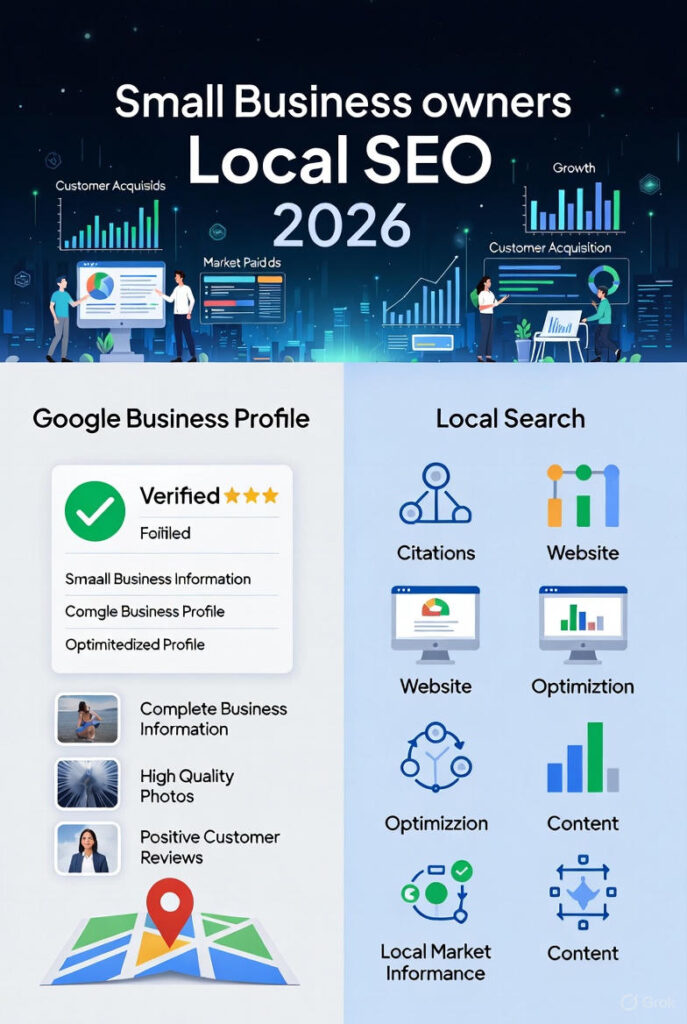
Small businesses live and die by local customers finding them. Google Maps and local search determine whether your restaurant, dental office, repair shop, or service business gets discovered by people actively looking for what you offer. The businesses that show up first in local results get the calls and customers. The ones buried on page two might as well not exist.
Local SEO isn’t complicated or expensive, but most small business owners either don’t know it matters or don’t prioritize it because results aren’t instant. This creates opportunity. Do the work consistently, and you’ll outrank competitors who can’t be bothered. The businesses winning local search aren’t spending thousands on consultants – they’re just executing basics that work.
Google Business Profile: Your Foundation
Your Google Business Profile is the single most important factor in local search visibility. This is the listing that shows up in Google Maps and in the local pack – those three businesses that appear above regular search results when someone searches for services in their area.
If you haven’t claimed and verified your business profile, do that immediately. It’s free, takes maybe thirty minutes, and Google will mail you a verification postcard or let you verify by phone. Without a verified profile, you’re invisible in local search regardless of anything else you do.
Once verified, complete every single field. Business name, address, phone number, website, hours, business categories, service areas, attributes – fill in everything Google gives you. Businesses with complete profiles rank higher than those with sparse information. It signals to Google that you’re a legitimate, active business.
The business description field allows 750 characters. Use them. Describe what you do, who you serve, what makes you different, and include relevant keywords naturally. Don’t stuff keywords awkwardly, but do mention the services and location terms people search for. A dentist in Phoenix might mention “family dentistry Phoenix,” “cosmetic dental work,” “emergency dental services” naturally within a readable description.
Categories matter enormously. Your primary category should be the most specific option that describes your main business. A pizza restaurant should choose “Pizza restaurant” not just “Restaurant.” Google shows businesses in search results based on category relevance, so picking the right primary category is crucial. You can add secondary categories for additional services, but the primary category carries the most weight.
Photos make a huge difference in engagement. Businesses with photos get more clicks, calls, and direction requests than those without. Upload exterior photos so people recognize your building. Interior shots show your space. Photos of your team humanize your business. Product or service photos demonstrate what you offer. Aim for at least 20-30 quality photos, and add new ones monthly to keep the profile active and fresh.
Reviews: The Trust Factor That Ranks You Higher
Google heavily weights reviews in local ranking algorithms. More reviews plus higher average ratings equals better visibility. This isn’t hidden – Google openly acknowledges reviews matter for ranking.
The challenge is most satisfied customers don’t leave reviews unless asked. They had a fine experience, paid, left, and never think about it again. Getting reviews requires a system for requesting them.
The simplest approach: after completing a service or transaction, send a follow-up message thanking them and including a direct link to your Google review page. Make it as easy as possible. The fewer steps between the request and writing the review, the higher your response rate.
Timing matters. Ask within a day or two while the experience is fresh. Wait a week and they’ve moved on mentally. Ask too quickly and they might not have fully experienced the service. A day or two hits the sweet spot.
What you say matters too. Don’t beg or sound desperate. Don’t offer incentives, which violates Google’s terms. Simply express appreciation for their business and mention that reviews help other customers find you. Most people are willing to spend two minutes helping a business they liked.
Responding to every review, positive and negative, shows Google and potential customers that you’re engaged. Thank people for positive reviews specifically – mention something about their experience rather than generic “thanks for the review” responses. Address negative reviews professionally, apologize for issues, explain what happened if appropriate, and offer to make it right. How you handle criticism tells potential customers how you’ll treat them if something goes wrong.
Never buy fake reviews or offer incentives for positive reviews. Google catches this eventually and can suspend your profile entirely. The short-term boost isn’t worth losing your entire local presence. Build reviews legitimately over time – 50 honest reviews over six months beats 200 suspicious reviews that get you penalized.
Citations: Your Business Mentioned Everywhere
Citations are mentions of your business name, address, and phone number on other websites. Think of them as the internet confirming your business actually exists. Yelp, Facebook, Apple Maps, industry directories, local business listings – each citation reinforces to Google that you’re a real business at that location.
Consistency matters more than volume. If your business is listed as “Mike’s Auto Repair” on Google but “Mike’s Auto Repair Shop” on Yelp and “Mike’s Automotive Repair” on Facebook, Google sees these as potentially different businesses. Make sure your business name, address format, and phone number are identical across all platforms.
Start with major platforms – Yelp, Facebook, Apple Maps, Bing Places. Then add industry-specific directories. Mechanics should be on automotive directory sites. Restaurants should be on food review platforms. Contractors should be on home services directories. These niche citations sometimes carry more weight than generic directory listings because they’re relevant to your industry.
Building citations is tedious but straightforward. Claim your business on each platform, fill out the profile completely, and ensure information matches exactly. This might take a full day initially, but once it’s done, you’re just maintaining rather than building from scratch.
Website Optimization for Local Search
Your website needs clear signals about where you’re located and what services you offer. Google needs to understand not just that you’re a dentist, but that you’re a dentist in a specific city serving specific neighborhoods.
Include your city and region naturally throughout your website copy. The homepage should mention your location. Service pages should reference the areas you serve. About page should talk about serving the local community. Contact page obviously lists your address.
Create location-specific content if you serve multiple areas. A plumber serving three neighboring cities could have dedicated pages for “Plumbing Services in [City A],” “Emergency Plumber [City B],” etc. These aren’t just duplicate pages with city names swapped – they should have unique content about serving that specific area.
Schema markup is technical but important. It’s code that tells Google specific information about your business – your business type, location, hours, services, reviews. Most website builders have plugins that add schema automatically. If you’re on WordPress, plugins like Yoast SEO or Rank Math handle this. The technical details matter less than ensuring your site has proper schema implemented.
Mobile optimization is non-negotiable. Most local searches happen on phones. If your website loads slowly or looks broken on mobile, people bounce immediately. Google knows this and ranks mobile-friendly sites higher. Test your site on your phone. If anything is hard to use, fix it.
Clear calls-to-action matter for conversions. Your phone number should be clickable on mobile so people can call with one tap. Your address should link to directions. Contact forms should be simple and obvious. You might rank first in local search, but if your website makes it hard to contact you, you’re losing customers to competitors with clearer CTAs.
Content That Attracts Local Searches
Creating content that answers common customer questions helps both ranking and conversion. A pest control company could write articles about common pests in their area, seasonal pest problems, DIY prevention tips. This content attracts searches, positions them as experts, and keeps people on their site longer.
The content doesn’t need to be Shakespeare. It needs to be helpful and include relevant local keywords naturally. “Dealing with Termites in Phoenix Homes” or “Winter Pest Prevention Tips for Arizona Homeowners” – these target local searches while providing value.
Blog consistently but realistically. One solid article monthly beats four rushed ones. Google values consistent fresh content, but quality matters more than frequency. Write content that actually helps your target customers, and the SEO benefits follow naturally.
Local news and community involvement generate content opportunities. Sponsoring a little league team, participating in community events, local partnerships – these activities create content you can share and often result in other local websites linking to you. Those local backlinks signal relevance to Google.
The Compounding Effect of Consistency
Local SEO improvements compound over time. Your first month of optimizing might move you from position eight to position five in local search. Not thrilling. But keep optimizing – more reviews, more citations, fresh content, better website – and three months later you’re in the top three. Six months later you’re consistently first or second.
The businesses that dominate local search aren’t necessarily doing anything sophisticated. They’re just consistent about the basics. They ask for reviews regularly. They keep their Google profile updated. They add new photos monthly. They respond to customer inquiries quickly. They maintain accurate information everywhere.
Your competitors are probably inconsistent. They optimize for a few weeks when they remember, then forget about it for months. They stop asking for reviews once they have twenty. They never update their photos or business description. This inconsistency creates opportunity for businesses willing to do the work ongoing.
Track what matters: your ranking position for key terms, calls and direction requests from Google, website traffic from local search, conversion rate from visitors to customers. These metrics tell you if your efforts are working. If you’re getting more visibility but not more customers, your website or sales process needs work. If customers are finding you but choosing competitors, you need to improve your offering or how you present it.
Local SEO isn’t instant gratification. It takes three to six months of consistent work before results become obvious. But unlike paid advertising where you stop getting traffic the moment you stop paying, organic local search visibility persists. The work you put in builds an asset that keeps generating customers without ongoing ad spend. For small businesses with tight marketing budgets, that’s hard to beat.