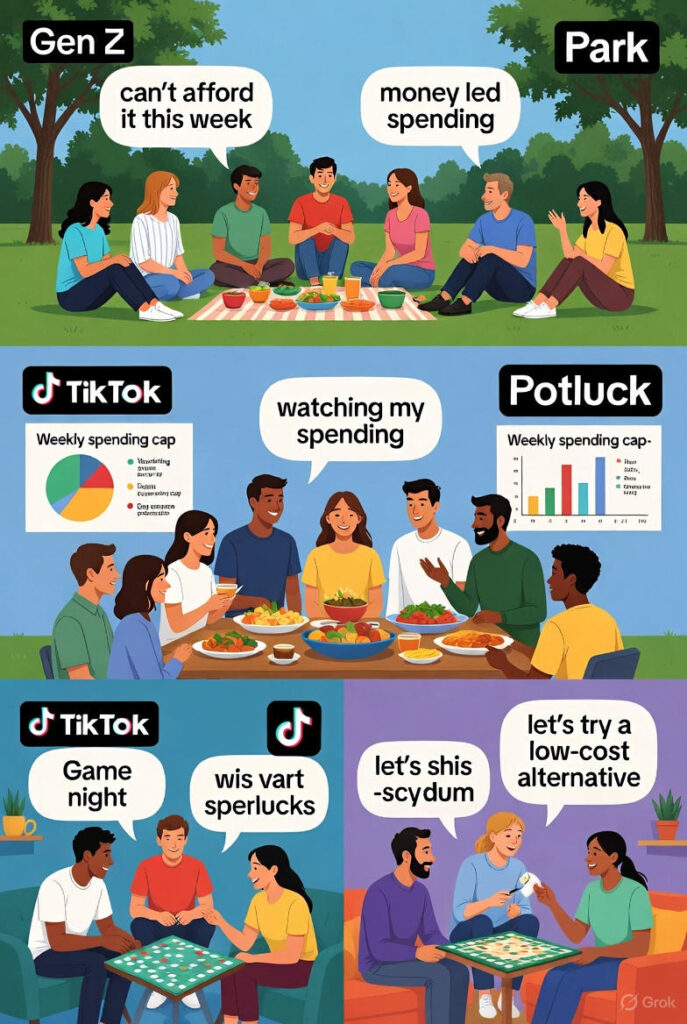
Something’s shifting in how younger people talk about money, and it’s catching the rest of us off guard. My friend Sarah turned down drinks last Thursday with a simple “can’t afford it this week” – no elaborate excuse about early morning meetings or family obligations. Just honest financial boundaries. The table went quiet for a second, then someone else admitted they were also watching their spending, and suddenly three other people were nodding in agreement.
This is loud budgeting, and it’s spreading fast beyond Gen Z into millennial and even Gen X circles. The concept flips traditional money shame on its head. Instead of quietly overspending to avoid awkwardness or inventing excuses to decline invitations, people are getting comfortable saying no based purely on their budget. There’s no guilt attached anymore, which feels almost radical compared to how previous generations handled these situations.
The origins trace back to TikTok, naturally, where creator Lukas Battle coined the term in late 2023. But it resonated because it named something people were already feeling – exhaustion from keeping up appearances and pretending they had more disposable income than reality allowed. Social media had created this pressure to document expensive experiences, and loud budgeting became a counter-movement. A way to reclaim financial sanity.
Part of what’s driving this cultural shift is treat math, a calculation method where you figure out how many work hours something costs before buying it. That $15 cocktail? For someone earning $30 an hour after taxes, that’s thirty minutes of their life. The $200 concert ticket becomes nearly seven hours. When you frame purchases this way, impulse spending gets harder to justify. You start asking yourself if the experience is worth the time you traded for it.
Treat math works because it connects abstract money to concrete reality. We all understand time viscerally – thirty minutes feels real in a way that $15 sometimes doesn’t. This mental shift helps people pause before swiping their card, which is exactly the friction point where better financial decisions happen.
Setting weekly spending caps for 2026 requires more honesty than most budgeting advice admits. The standard recommendation is to track expenses for a month, categorize everything, then set limits. That’s fine in theory, but most people abandon tracking after two weeks because it’s tedious. A simpler approach: you need to know your actual take-home pay (not just salary), subtract fixed costs like rent and insurance, allocate savings first, then divide what remains by four. That number becomes your weekly discretionary budget.
Let’s walk through a real example. Say you bring home $4,200 monthly after taxes and 401(k) contributions. Your rent is $1,400, utilities average $150, car payment and insurance total $450, groceries run about $400, and you’re putting $300 into an emergency fund. That’s $2,700 in fixed monthly obligations, leaving $1,500 for discretionary spending. Divide by 4.3 weeks per month (not four), and you get roughly $350 weekly for everything else – dining out, entertainment, clothing, hobbies, gifts, personal care.
Most people mess this up by being too optimistic about their fixed costs or forgetting irregular expenses. Car registration in March, holiday gifts in December, that annual insurance premium, subscription renewals, haircuts, pet care – these need to factor into your calculations upfront. Otherwise you’re setting caps you can’t actually maintain, which leads to guilt and abandoning the system entirely.
A better method is adding 15-20% to your estimated fixed costs to account for irregulars. So in the example above, you might set aside an additional $400-500 monthly for those unpredictable but inevitable expenses. This reduces your weekly discretionary budget to around $300, but it’s a number you can actually live within.
The mechanics of tracking weekly spending have gotten easier with app technology, but sometimes low-tech works better. Some people withdraw their weekly cash allowance and only spend that physical money. When it’s gone, they’re done spending until next week. This creates a tangible limit that’s harder to ignore than a number in an app. Others use separate checking accounts – one for fixed bills, one for discretionary spending – and only carry the debit card for the discretionary account.
The uncomfortable truth about loud budgeting is that it works best when everyone around you respects financial boundaries. If your social circle pressures you to spend anyway or makes you feel cheap for declining invitations, being loud about your budget just creates friction without solving the underlying problem. You might need to have harder conversations about suggesting lower-cost alternatives or finding friends who share your financial priorities.
But more people are finding that honesty strengthens friendships rather than weakening them. Turns out most of us are relieved when someone else admits they’re watching their spending. It gives everyone else permission to drop the facade. The friends who judge you for having financial boundaries probably weren’t great friends to begin with.
One unexpected benefit of loud budgeting is it forces you to get creative about socializing. Instead of defaulting to expensive restaurants or bars, you start suggesting parks, potlucks, game nights at home, free community events. These often end up being more memorable than generic dinners out because they require more thought and engagement.
The practice also bleeds into other spending categories. Once you start being honest about what you can’t afford socially, it becomes easier to apply the same logic to subscription services you barely use, gym memberships you don’t visit, or retail therapy purchases that sit unworn in your closet. Loud budgeting becomes a gateway to broader financial consciousness.
Critics argue this is just basic budgeting repackaged with a trendy name, and they’re not entirely wrong. But the cultural permission structure matters. Giving something a name and watching others practice it publicly makes it feel achievable rather than shameful. That psychological shift might be exactly what moves people from knowing they should budget to actually doing it consistently.
As we move deeper into 2026, expect loud budgeting to evolve beyond just declining invitations. People are starting to negotiate bills, question fees, push back on lifestyle inflation, and openly discuss money with partners and friends in ways that would have felt taboo five years ago. The normalization of financial honesty might end up being Gen Z’s most lasting contribution to personal finance culture.