

Credit scores feel mysterious because the credit bureaus benefit from confusion. The less people understand about how scores actually work, the more they’ll pay for credit monitoring services, score-boosting products, and repair programs that promise magical fixes. Most of what people believe about building credit is either outdated, oversimplified, or just wrong.
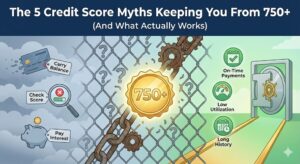
Getting to a 750+ credit score isn’t complicated once you understand what actually matters. The problem is separating useful information from myths that waste your time or actually hurt your score. Let’s clear up the five biggest misconceptions keeping people stuck with mediocre credit.
Myth 1: Carrying a Small Balance Helps Your Score
This one refuses to die despite being completely false. The belief goes that keeping a small balance on your credit card and making minimum payments shows you’re using credit responsibly. Banks supposedly like seeing you carry balances because it proves you’re a borrower who pays interest.
The truth is credit scoring models don’t care whether you’re profitable for banks. They care about risk. Someone carrying balances looks riskier than someone paying in full because carrying debt suggests tighter finances and higher chance of eventual default.
Your credit utilization – the percentage of available credit you’re using – is the second most important factor in your score after payment history. Using more than 30% of your available credit starts hurting your score. Using more than 50% hurts substantially. The optimal utilization for maximizing your score is actually under 10%, and even lower is better.
Here’s how it works practically. Say you have a credit card with a $5,000 limit. Using $4,000 of it means 80% utilization, which tanks your score even if you pay on time. Using $500 means 10% utilization, which is ideal. Using zero technically looks like you’re not using credit at all, but it still scores better than high utilization.
The confusion comes from mixing up two different things. You do need to use your cards occasionally to keep accounts active. A card sitting unused for months might get closed by the issuer. But “using” your card doesn’t mean carrying a balance month-to-month. It means making purchases and paying them off completely before the statement closes or before the due date.
The optimal strategy is using your cards regularly for normal purchases, then paying the full statement balance before the due date. You get the benefit of active accounts and on-time payments without paying any interest or showing high utilization. This maximizes your score while costing you nothing.
If you’re currently carrying balances because you thought it helped your score, pay them off as quickly as possible. The interest you’re paying accomplishes nothing positive for your credit and costs you money for no benefit.
Myth 2: Checking Your Own Credit Hurts Your Score
This myth makes people afraid to monitor their own credit, which is exactly backwards. The fear comes from confusing two completely different types of credit inquiries – hard pulls and soft pulls.
Hard inquiries happen when you apply for credit. You apply for a credit card, auto loan, or mortgage, and the lender pulls your credit report to evaluate the application. These inquiries do affect your score slightly – typically dropping it by 5 to 10 points temporarily. Multiple hard inquiries in a short period look like you’re desperate for credit, which signals risk.
Soft inquiries happen when you check your own credit, when credit card companies check your credit to send pre-approved offers, when employers run background checks with your permission, or when you use credit monitoring services. Soft inquiries don’t affect your score at all. They show up on your credit report but lenders can’t see them and they have zero impact on scoring.
Checking your own credit through AnnualCreditReport.com, Credit Karma, or directly through the credit bureaus is always a soft inquiry. You can check as often as you want without any negative effect. In fact, regularly checking your credit is smart financial hygiene because it lets you catch errors, spot identity theft, and understand what’s affecting your score.
The confusion sometimes comes from people checking their credit right before applying for loans, then seeing their score drop and blaming the credit check. But what actually hurt their score was the hard inquiry from the loan application itself, not from checking beforehand.
You should check your credit reports at least quarterly. The three bureaus – Experian, Equifax, and TransUnion – sometimes have different information, so checking all three matters. Errors are more common than people think, and they won’t get fixed if you don’t know they’re there.
If you find errors, disputing them is straightforward. Contact the bureau showing the error through their website or mail, explain what’s wrong, provide documentation if you have it, and they’re legally required to investigate within 30 days. Many errors get removed easily because creditors don’t bother responding to disputes about old minor issues.
Myth 3: Closing Old Credit Cards Improves Your Score
The logic behind this myth sort of makes sense. Fewer open accounts means less credit available, which should mean less risk, right? And having a bunch of old cards you don’t use cluttering up your credit report seems messy. So closing them should clean things up and maybe even improve your score.
Except credit scoring works opposite to this intuition. Closing credit cards typically hurts your score, sometimes significantly, for two reasons.
First, it reduces your total available credit, which increases your utilization ratio. Say you have three cards with $3,000 limits each, for $9,000 total available credit. You’re carrying $1,500 in balances across all cards, which is 17% utilization – perfectly fine. Now close one card. Your available credit drops to $6,000, but your balance stays at $1,500, so your utilization jumps to 25%. Your score drops because your utilization increased, even though your actual debt didn’t change at all.
Second, closing old accounts can reduce your average account age. Credit scoring rewards long credit histories. An account you opened ten years ago that’s still open boosts your average account age. Close it, and that account eventually falls off your report entirely, shortening your credit history.
The exception is closed accounts remain on your report for up to ten years, so closing a card doesn’t immediately destroy your credit age. But eventually that account ages off, and if it was your oldest card, your credit history suddenly looks much shorter than it did.
The better strategy for cards you’re not using is keeping them open but inactive, or putting a small recurring charge on them – a streaming subscription, a monthly donation, whatever – and setting up autopay. This keeps the account active, maintains your available credit, and preserves your credit age without requiring you to think about the card.
The only time closing cards makes sense is if they have annual fees you don’t want to pay, or if you genuinely can’t trust yourself not to run up debt if the credit is available. But for most people, keeping old cards open helps your score more than closing them does.
If you already closed old cards thinking it would help, there’s no way to undo it. Those accounts will age off your report eventually. The fix is opening new accounts and being patient while they age, and not closing any more cards unnecessarily.
Myth 4: You Need to Pay Interest to Build Credit
This is probably the most expensive myth because it costs people real money. The belief is that credit card companies and lenders want to see you paying interest because it proves you’re profitable to work with. Therefore, paying your balance in full supposedly doesn’t build credit as effectively as carrying balances and paying interest.
This is completely false and likely persists because it benefits credit card companies financially. If people believe they need to pay interest to build credit, they’ll carry balances and pay interest unnecessarily.
Credit scoring models don’t know or care whether you’re paying interest. What gets reported to credit bureaus is whether you make payments on time, how much you owe relative to your limits, and how long you’ve had credit. Whether you pay interest has zero impact on any of these factors.
Making on-time payments for the minimum amount due builds credit just as effectively as making on-time payments for the full balance. But paying the minimum means you carry a balance, which increases your utilization, which hurts your score. And obviously you’re paying interest, which costs money for no benefit.
The optimal approach is using credit cards for purchases you’d make anyway, then paying the statement balance in full before the due date. You get all the credit-building benefits – on-time payments, active accounts, credit mix – without paying a cent in interest.
New credit users sometimes worry that if they pay their balance before the statement closes, nothing gets reported to the credit bureaus and they get no credit-building benefit. This isn’t quite right. What gets reported is your statement balance – whatever you owe when the statement closes. If you pay before the statement closes, your statement balance is zero, which gets reported as zero utilization. This is actually ideal for your score.
Some people prefer letting a small balance hit the statement then paying it off immediately after to show low but non-zero utilization. Either approach works fine. What doesn’t work is carrying balances month-to-month and paying interest thinking it helps your credit. It doesn’t, and it’s costing you money.
If you’re currently in a situation where you can’t pay your full balance because of financial constraints, that’s different – you’re not choosing to carry a balance, you temporarily don’t have the money to pay it off. That’s understandable and sometimes unavoidable. But once you do have money available, paying off balances completely is always the right move for both your wallet and your credit score.
Myth 5: Credit Repair Services Can Fix Bad Credit Quickly
Credit repair companies advertise heavily, promising to boost your score by 100+ points in 30 to 60 days by removing negative items from your report. Some claim to have special insider knowledge or relationships with credit bureaus. Others position themselves as legal advocates who know loopholes in credit reporting laws.
The truth is credit repair companies can’t do anything you can’t do yourself for free, and many use tactics that are questionable or outright illegal.
Legitimate negative information – late payments, collections, bankruptcies – can’t be removed unless it’s inaccurate or past the reporting time limit. Late payments stay on your report for seven years. Bankruptcies stay for seven to ten years depending on type. Collection accounts stay for seven years. These timeframes are set by federal law, and no one can legally remove accurate information before it ages off naturally.
What credit repair companies actually do is dispute everything on your report, accurate or not, hoping the creditor won’t respond within 30 days. If the creditor doesn’t respond, the credit bureau has to remove the item temporarily. The repair company declares victory and collects their fee.
The problem is most creditors do respond eventually, and the negative item comes back. You’ve paid $500 to $1,500 for temporary removal that doesn’t stick. Worse, some repair companies’ tactics violate federal law, and you can be held responsible even though you hired them to act on your behalf.
The Credit Repair Organizations Act makes it illegal for credit repair companies to lie about what they can do, charge upfront fees before providing services, or advise you to dispute accurate information. Many companies violate these rules routinely.
If you have legitimate errors on your credit report – accounts that aren’t yours, payments marked late that you made on time, incorrect balances – you can dispute them yourself for free directly with the credit bureaus. The process is straightforward: submit a dispute online or by mail, provide documentation if you have it, and the bureau investigates within 30 days.
For accurate negative information that’s hurting your score, the only real solution is time and building positive payment history. As negative items age, they matter less. After two or three years, a late payment from the past has minimal impact if you’ve made all payments on time since then. Focus on paying everything on time going forward and your score will gradually improve.
Some people consider “goodwill letters” where you contact creditors directly and ask them to remove accurate but old negative information as a courtesy. Success rates are low, but it costs nothing to try. Write a polite letter explaining the circumstances that led to the late payment, emphasize that it was an isolated incident, and request removal as a goodwill gesture. Some creditors will do this for long-time customers with otherwise clean records, but many won’t respond at all.
What Actually Works for Building Credit
Now that we’ve cleared up what doesn’t work, here’s what does:
Make every payment on time, always. Payment history is 35% of your credit score. One 30-day late payment can drop your score by 60 to 100 points. Set up autopay for at least the minimum payment on every account to ensure you never miss a due date, even if you plan to pay more manually.
Keep utilization under 10%. Use your credit cards but pay them down before balances get high. If you have trouble with this, pay your balance multiple times per month rather than waiting for the statement. You can pay down your card balance any time, not just when the statement arrives.
Keep old accounts open. Unless there’s a compelling reason to close them, let old credit cards remain open even if you barely use them. Your oldest account is probably your most valuable one for scoring purposes.
Build a credit mix over time. Having both revolving credit like credit cards and installment loans like auto loans or mortgages helps your score more than having only one type. But don’t take out loans you don’t need just to diversify your credit mix – the benefit is small and not worth paying unnecessary interest.
Become an authorized user. If you’re building credit from scratch or recovering from bad credit, being added as an authorized user on someone else’s old, well-managed account can boost your score quickly. You inherit the account’s payment history and age. Just make sure the primary cardholder has excellent payment history, or this strategy backfires.
Be patient. Building great credit takes years, not months. Someone starting from scratch might need three to five years to reach a 750+ score even if they do everything right. Someone recovering from serious negative marks might need five to seven years for those marks to age enough that they stop mattering. There are no shortcuts, and anyone promising fast results is either lying or using tactics that won’t stick.
The credit scoring system rewards boring, consistent financial behavior over time. Pay your bills on time, keep your balances low, maintain old accounts, and wait. It’s not exciting, but it works reliably. Everything else is either myth, marketing, or misinformation designed to profit from people’s confusion about how credit actually works.