The freelancers making serious money right now aren’t necessarily more talented than they were two years ago. They haven’t suddenly become better designers or faster writers or more strategic consultants. They’ve just figured out how to use AI tools without letting those tools devalue their work. There’s a specific skill emerging that separates premium freelancers from everyone else – knowing exactly how to communicate with AI systems to get professional-grade output.
This isn’t about using AI to spam low-quality content and hoping clients don’t notice. That strategy crashed hard in late 2024 when clients got smart about detecting AI slop. The market corrected brutally – freelancers pumping out generic AI content saw their rates collapse to near zero because clients realized they could just use ChatGPT themselves for free.
The freelancers who survived and thrived are the ones treating AI as a force multiplier rather than a replacement for their expertise. They’re using these tools to handle repetitive tasks, accelerate research, generate first drafts, and explore options faster. But they’re still applying human judgment, industry knowledge, strategic thinking, and quality control that AI can’t replicate.
Prompt engineering sounds more technical than it actually is, which has created a weird skill gap. Non-technical people hear “engineering” and assume it requires coding knowledge. It doesn’t. At its core, prompt engineering is about understanding how to structure requests to AI tools so they produce usable results instead of generic garbage. It’s part art, part science, and absolutely learnable.
A graphic designer who writes vague prompts to Midjourney gets vague results – generic imagery that looks like everything else flooding social media. Someone who specifies style references, composition rules, color theory principles, cultural context, and emotional tone gets something they can actually refine into client-ready work. The difference between “design a logo for a coffee shop” and “design a minimalist logo for a specialty coffee roaster targeting urban professionals, inspired by Scandinavian design principles, using a muted earth tone palette, emphasizing negative space and geometric forms” is the difference between worthless output and a genuine starting point.
The same principle applies across every creative and knowledge work field. A writer prompting AI with “write a blog post about marketing” gets exactly what you’d expect – bland, generic, useless. A writer providing detailed briefs including target audience demographics, desired tone and voice, specific points to cover, examples of what good looks like, and constraints on what to avoid gets a draft that might need 30% editing instead of 80% rewriting.
The multiplication effect is real and measurable. A writer who used to spend eight hours researching and drafting a white paper can now spend two hours crafting detailed AI prompts and outlines, let AI generate a comprehensive first draft in minutes, then spend six hours editing for accuracy, refining tone, strengthening arguments, and ensuring it matches the client’s voice. They’re delivering the same quality in less total time, which means they can take on more projects simultaneously or charge premium rates for fast turnaround.
Clients are starting to understand the difference between AI-generated slop and AI-enhanced professional work, and they’re willing to pay significantly different rates for each. The market is bifurcating. Bottom-tier freelancers are competing with AI tools directly and losing on price because clients realize they’re basically just feeding prompts to ChatGPT and charging a markup. Top-tier freelancers are using AI as power tools but maintaining premium positioning because they’re delivering better results faster.
There’s not much middle ground left. Freelancers who are neither cheap enough to compete with AI directly nor skilled enough to deliver AI-enhanced premium work are getting squeezed out. This is uncomfortable to talk about, but it’s showing up clearly in freelancer earnings data – the distribution is becoming barbell-shaped rather than bell-curve-shaped.
Web developers building sites with AI-assisted code can prototype complete applications in hours instead of days. They’re using AI to generate boilerplate code, suggest solutions to problems, debug issues faster, and even write basic test cases. But they’re still making architectural decisions, ensuring security best practices, optimizing performance, and understanding how everything fits together. The AI isn’t replacing their expertise – it’s removing grunt work so they can focus on the parts that actually require human judgment.
Marketing strategists using AI for audience research, competitive analysis, and campaign ideation can present more comprehensive proposals without inflating their billable hours. They’re getting AI to analyze thousands of data points, identify patterns, suggest approaches, and even draft initial copy. But they’re the ones understanding business context, making strategic decisions, adapting ideas to specific brands, and ensuring everything aligns with broader marketing goals.
Video editors using AI for rough cuts, transcription, subtitle generation, and even some basic color correction can spend their creative energy on storytelling, pacing, emotional beats, and artistic choices instead of technical grunt work. The AI handles the tedious parts – syncing audio, identifying scene changes, generating first-pass edits. The human editor then shapes that raw material into something compelling.
The business model shift is subtle but important. You stop selling hours and start selling outcomes. A logo designer who quotes $500 for “20 hours of work” sounds expensive, and clients start doing math on hourly rates and questioning why it takes so long. The same designer quoting $1,500 for “a complete brand identity package delivered in 48 hours” sounds like a deal because the client is buying speed, expertise, and results rather than time.
AI tools make the 48-hour timeline possible without pulling all-nighters or sacrificing quality. But from the client’s perspective, they don’t care how you did it – they care that they got great work faster than they expected. The ability to deliver quickly has become its own value proposition, especially for businesses operating on tight timelines.
Not every client is ready to pay premium rates, which means part of this strategy involves client selection and positioning. You’re filtering for businesses that value speed, quality, and reliability over rock-bottom pricing. Those clients exist in every industry – they’re just not usually posting $50 gigs on Fiverr or shopping purely on price.
Premium clients tend to find freelancers through referrals, portfolio work, thought leadership content, or specialized platforms. They’re looking for someone who understands their industry, can work independently without hand-holding, and delivers results that move their business forward. Price is a consideration but not the primary one.
The freelancers struggling right now are the ones in two extremes. First, those refusing to touch AI tools out of principle or fear, insisting they’ll compete on pure human craft. Noble sentiment, but economically brutal because they’re competing on time spent rather than value delivered. They’re working twice as hard to deliver the same outcome as someone using AI enhancement.

Second extreme: freelancers relying on AI completely without adding human judgment, expertise, or quality control. They’re essentially running prompt-to-delivery services, and clients are figuring out they can cut out the middleman. These freelancers built businesses on information asymmetry – clients didn’t know how easy it was to generate certain types of content. That asymmetry is disappearing.
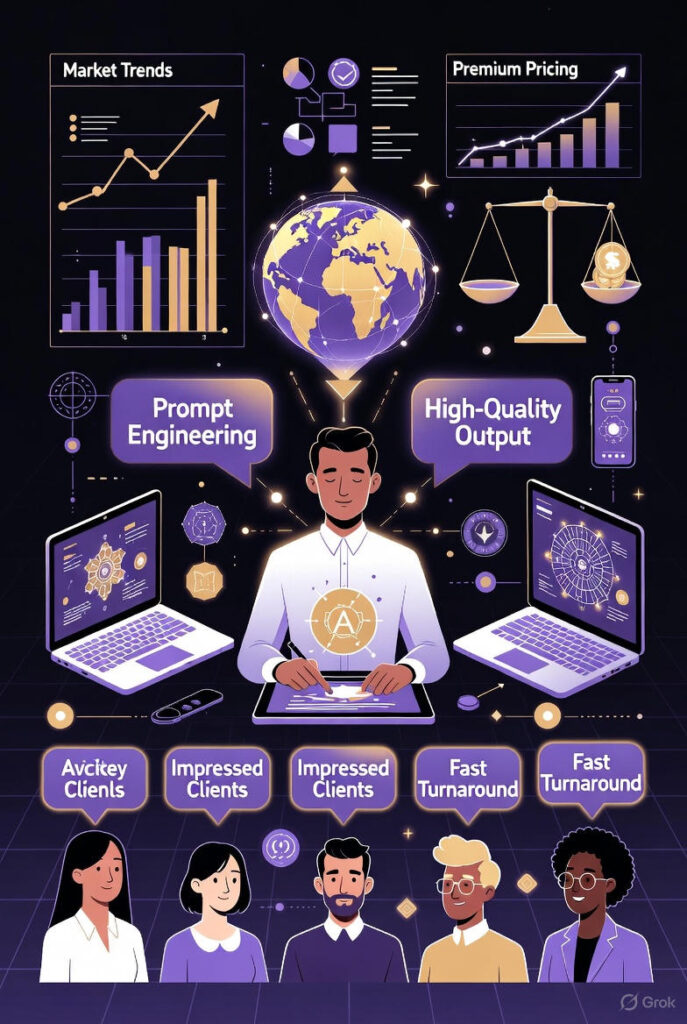
The premium is in the combination – AI speed with human expertise. Know your craft deeply enough that you can spot when AI produces something subtly wrong. Understand your clients’ businesses well enough that you can adapt AI-generated ideas to their specific context. Maintain quality standards that AI alone can’t meet. That’s where the 3X pricing comes from.
Some tactical considerations for freelancers wanting to make this transition:
Invest time in actually learning how AI tools work rather than just fumbling through. Take courses on prompt engineering, experiment extensively, build a library of effective prompts for common tasks. The upfront time investment pays off exponentially.
Be transparent with clients about using AI, but frame it around outcomes not tools. “I use the latest technology to deliver faster without sacrificing quality” works better than “I’m using ChatGPT for most of this.” Clients care about results, not your process.
Raise rates gradually while improving delivery speed and quality. If you’re delivering twice as fast with same quality, start charging 50% more per project. Test whether clients balk. Most won’t if you’ve positioned yourself well. Keep testing upward.
Specialize in areas where human judgment and expertise matter most. Pure content creation is commoditizing fast. Strategy, positioning, creative direction, industry-specific knowledge – these are harder for AI to replicate and command higher rates.
The gig economy in 2026 is rewarding people who figured out that AI tools are power tools, not replacements. A carpenter with a pneumatic nail gun charges more than one with a hammer because they work faster, not less. Same principle applies to knowledge work now. Master the tools, maintain the craft, deliver the value, charge accordingly.